
PHASETAPE · PRIVATE BETA NOW OPEN
Your nodal environment. Modulate everything, anywhere, in any DAW.
A nodal canvas, 66 native nodes and your VSTs wired freely, modulation on any parameter, even on third-party plugins, and a patch that travels everywhere. One timeline, one hub, audio bridges between apps. All in a single plugin, on macOS and Windows, in the DAW you already love.
Compatible with
manifesto
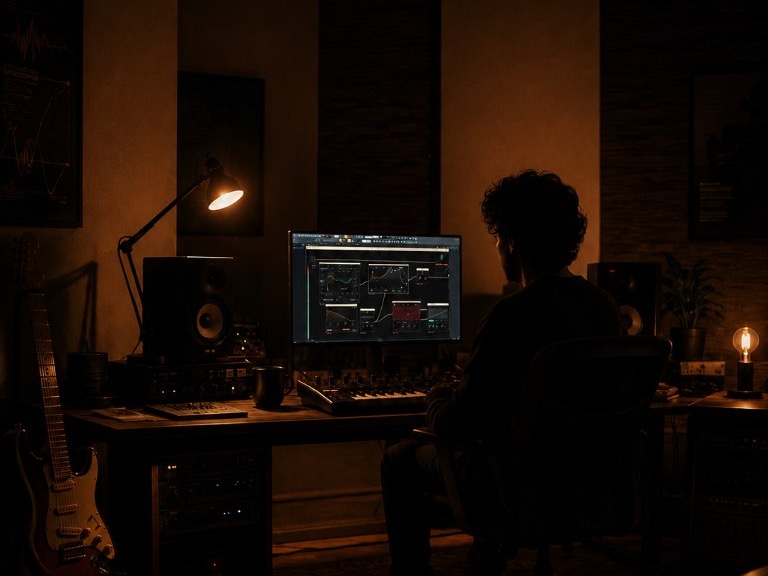
"The tools were limiting my music."
Every DAW imposes its own logic: tracks, serial racks, numbered inserts. You end up composing within the tool's limits, stacking plugins in the order it tolerates, and abandoning the routing idea that was stuck in your head. When you change studios, machines or software, everything stays behind: the chains, the presets, the hundreds of VSTs you depend on, the balance you found at three in the morning, and your habits.
Nodus flips that. An empty canvas, the freedom to wire what you want, in the direction you want: in series, in parallel, with every tool you need without depending on anything else, in any host, and a third-party VST in the graph only if you want it. Modulation isn't a feature buried in a submenu: it's the core. You drag an LFO to any parameter, including your favorite plugins. It's exactly what I wanted to do without changing DAWs.
And because a patch only matters if it follows you, everything you build travels: between your machines, between your DAWs, between macOS and Windows, even sending audio and MIDI live from one app to another. FL Studio controlling Bitwig. DaVinci Resolve talking to OBS. It didn't exist. I needed it. Now it's yours.
66
native nodes: synths, effects, modulators, MIDI, analysis
14
modulation sources, assignable to anything, even third-party VSTs
1 : 1
audio-rate modulation, computed sample by sample
0 ms
added latency on audio bridges between apps
2 min
between each automatic backup of your session
the canvas
A workspace, not a list of inserts.
Drop a node, pull a cable, listen. The canvas imposes neither order nor hierarchy: the signal goes where you decide. Series, parallel, multiband, sidechain: topology becomes visible and tangible.
- Gesture before menu. Drop a node on a cable: it inserts automatically. Duplicate by drag, swap two modules in one move. Modular synth ergonomics, at the keyboard and mouse, across your whole toolkit.
- Your VSTs, first-class citizens. A VST3 wires, modulates and presets like a native node. If a plugin is missing on load, nothing breaks: Nodus remembers manufacturer, version, position and offers to reconnect or replace it.
- Nodus inside Nodus. An entire patch becomes a node inside another patch. Build your own composite instruments, with reliable undo/redo even inside subgraphs.
the right gesture
An interface that disappears behind your hands.
Every interaction was designed as a short, consistent vocabulary of gestures you learn in one evening.
Focus
Audition any node in solo without touching the routing.
Bypass
Cut a module in one gesture and bring it back anytime.
Randomize
Shake the selected node's parameters with unsettling ease. Sometimes the accident is the right answer.
Full undo
Nodes, cables, LFO curves, piano roll, wavetables: everything undoes, everything redoes.
Insert on cable
Hover a connection, click, choose: the node inserts, the chain rewires itself.
Fine drag
Hold a modifier and dragging becomes surgical.
Compare
Compare as many nodes or branches as you want by ear. One click, your ears decide.
Hub
Presets, samples, wavetables, backups, account: the whole ecosystem behind one key, one click away anywhere on the canvas.
"A good tool doesn't get in the way. If you think about Nodus while you produce, I missed something."
modulation everywhere
Here, modulation isn't a feature. It's the raw material.
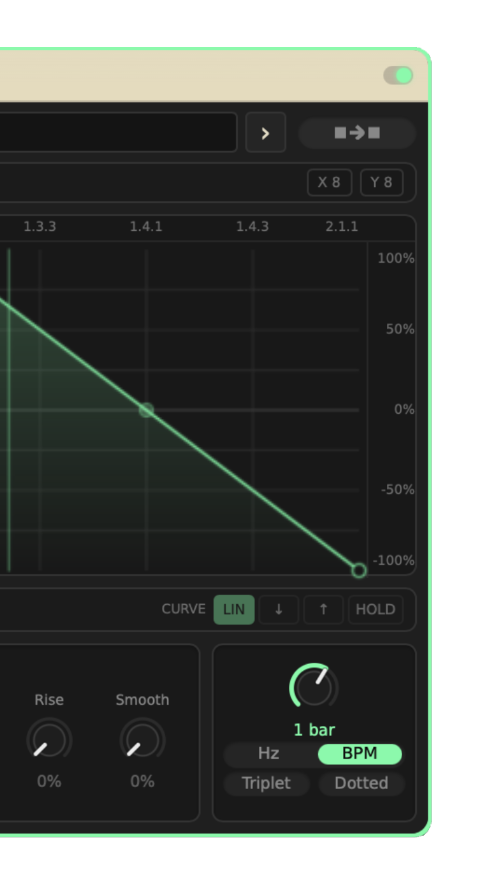
In most hosts, modulating a third-party plugin is duct tape. Not with Nodus. Here it's the basic gesture: drag a cable to any knob, native or VST, and it's done. Modulation is additive and non-destructive: your value stays intact, modulations stack, you control them separately or together, everything remaps.
- A matrix on every parameter. Right-click a modulatable parameter: see every source touching it, with depth, polarity, per-target bypass, mute and editable remap curve.
- Audio-rate, for real. The pipeline computes modulation sample by sample. An oscillator modulating a filter at 2 kHz is FM synthesis applied to anything in your effects chain.
- Visible on the canvas. Every link draws on the affected parameters and, in dashes, on the node itself, UI designed to avoid visual overload.
fourteen sources, each with its color, like in the plugin
Bezier-drawn shapes, shape presets, from slow drone to audio-rate tremor.
Graphical ADSR with tension curves, triggered by any MIDI cable in the graph.
Knobs automatically exposed to your DAW's automation.
Synced value sequencer, living playhead, lockable polarity.
Controlled chance: synced or free draws, smoothed or sharp.
Sample a source at the rate you impose. The grain of modular synths.
Four dimensions under one finger. Performance and live morphing.
Bilinear morphing between four full presets, like vector synthesis applied to the whole patch.
Your signal envelope (L, R, M or S) becomes a source, with post-analysis remap curve.
Modulation computed every sample. FM, AM, ring mod, on any parameter.
Played pitch redrawn as a free curve.
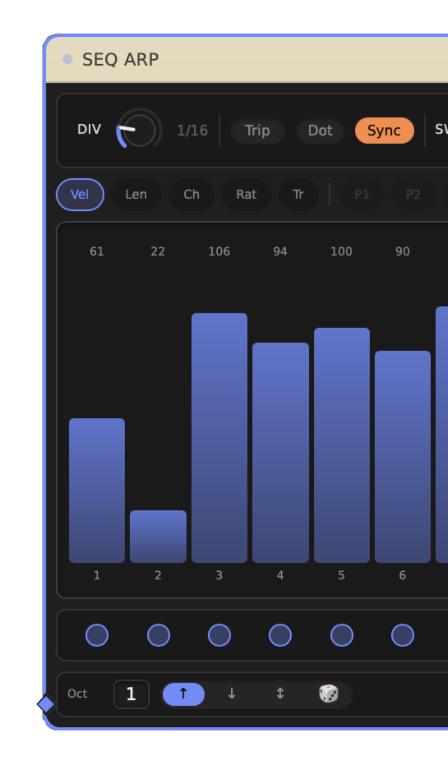
Sequential arpeggiator: a custom value grid follows your notes. Steps built for live playing.
MIDI gate: the source only lives while a note is held: envelopes and sweeps on touch.
Follows transport: rises on play, falls on stop.
Nodus doesn't "replace" your setting. You spent ten minutes finding the right cutoff? It's still there, under the modulation. Cut all sources and you get exactly your sound back.
native ecosystem
66 native nodes. Everything you need to produce, plus innovations.
Every module was born from a concrete session need. The catalog covers nearly a full production workflow: synthesis, dynamics, space, distortion, routing, MIDI, analysis, often with an angle nobody else offers.
Why 66 native nodes?
Because depending on dozens of different plugins is frustrating. On one, the modulator exists. On another, it doesn't. Switch DAWs to collaborate and nothing works the same. Every new machine becomes a hunt: a VST is missing, the version is obsolete, the license won't activate.
Nodus is a promise: one download, installable everywhere, usable in any DAW, with everything you need to produce already inside.
- It opens. Period. macOS, Windows, Live, Reaper, Logic, Bitwig. Your patch travels without breaking, even if a third-party VST is missing.
- Built to take the load. Every node is shaped to survive large graphs. No bloat, just what serves.
- Innovations that shift the game. Draw a wavetable by curve, psychoacoustic simulation reverb, and plenty of other ideas.
- And your VSTs stay. Keep your favorite plugins, wired and modulated like native. The foundation doesn't replace, it liberates.
Nodus doesn't ask you to give up your plugins. It gives them a better place to live: wired freely, modulated like native, saved with the patch. The native foundation exists so your project opens everywhere, even on the machine missing half your collection. That's exactly my case on tour or when I collaborate on something other than my own computer.
cross-connect
Audio/MIDI between two apps. Live. Nothing like this since ReWire.
Drop a Nodus instance in FL Studio, another in Bitwig. Name a channel. Audio, MIDI, clock and CC cross through a shared-memory bus: no virtual driver, no compensation latency. Direct transfer.
Shared memory · 16,000-frame ring buffer · zero copy, zero artificial latency
- And the patch travels too. A .nodus file embeds the graph, presets and dependencies. It opens identically on macOS and Windows, in any DAW.
- Snippets to move fast. A mastering chain, a sound-design rack: save any fragment as a .nodussnippet and drop it in the next project. Copy/Paste work anywhere.
timeline & arrangement
And when the idea becomes a track, the timeline is already there.
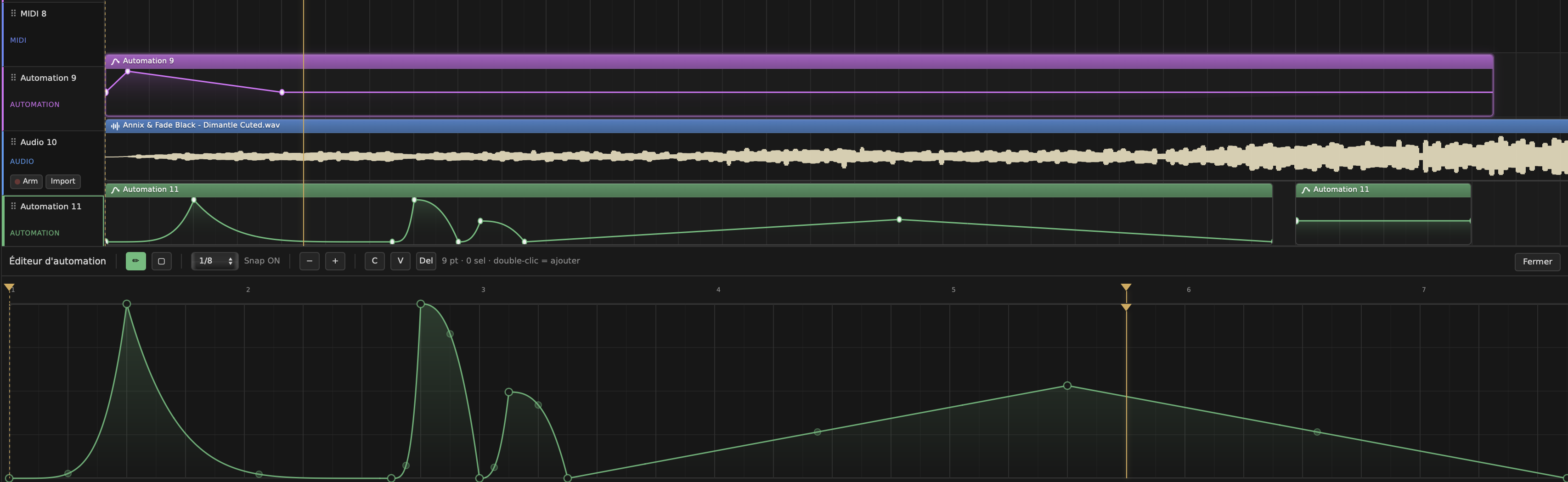
One toggle and the canvas gives way to an arrangement view: audio tracks, MIDI clips, piano roll, automation curves linked to the graph's modulators. Nodus is a modular nodal DAW wrapped in a plugin, with a standalone version too.
Full piano roll
Draw, select, velocity with snap, deep zoom, full undo. The grid is shared with the timeline: what you quantize here stays consistent there.
Automation talks to the canvas
An automation curve isn't just a parameter: it can drive a modulator in the graph. The line between composing and sound design blurs.
Multitrack recording
Arm multiple tracks, set a punch zone, play. Clips can share the same audio source: duplicating a take doesn't duplicate the file.
Synced transport
Play in the DAW, play in Nodus, or the other way around. Transport is bidirectional, edit cursor independent from playhead, at 60 fps.
In active development. Nodus is in beta, and the timeline is part of what I'm actively working on for the final release. The ambition: explore what a piano roll becomes when it lives inside a modular graph.
the hub · tab key
Everything that makes your sound, under one key.
Tab: a glass panel opens over the canvas. Inside, all your material: presets, fragments, samples, wavetables, backups, account. A library built for session speed.
- Presets at three levels. Full patch, single-node preset (even external VST), or graph snippet. Tags, fuzzy search.
- Automatic backups. Snapshots every 2 minutes, rotating, silent, restorable from the Hub. Never lose what you're building.
- Built-in feedback. A bug or idea? The form is right inside the plugin. The shortest path from your observation to my response.
built to last
Beauty isn't enough. It has to survive the session.
A creative tool that crashes at hour four isn't a creative tool. Nodus is built with one obsession: building the tool of my dreams.
A real-time engine
Native DSP optimized to run as close to the metal as possible, with minimal overhead. Even a large graph stays fluid.
CPU, shown per node
Every module shows its real cost in milliseconds and percent of your machine. The graph tells you exactly where it heats up.
Bounce: freeze without giving up
A chain getting heavy? Freeze it to audio, reclaim CPU, keep going. The original graph stays there, ready to unfreeze when you need it.
Undo/redo, all the way
One undo stack: nodes, cables, LFO curves, piano roll, wavetables, subgraphs. Cmd+Z keeps its word.
A crash live is an audience waiting. A crash in the studio is an idea dying. I treat both as top-priority bugs.
learn · customize · connect
The engine matters. What you experience around it too.
A deep tool has no right to be opaque. I cared for the moments that make software yours: learning, ownership, and direct feedback.
learn
A tutorial that shows instead of explaining
Contextual coach marks, chapters with animated illustrations, modular can intimidate; learning shouldn't.
customize
Your theme, down to the cables
A full theme editor with live preview: surfaces, accents, category colors. Named presets persisted to disk, and palettes designed with color blindness in mind. It's your tool, it should feel like you.
connect
Feedback is part of the product
A bug, an idea? The form is in the Hub, two clicks from your session. I read every report myself, and you'll often see yours in the release notes the following week. Discord continues the conversation.
Join Discord →about · me
Who am I?
My name is Mona, better known as Eluun, my artist name. I've been making electronic music for 18 years. Nodus was born from a need. For about ten years I've felt limited by my main DAW, constantly juggling to move forward and innovate in my music and sound design, simply because it wasn't built for that, and the business models behind it don't push those teams toward power users like me.
I've seen revolutionary alternatives appear: other DAWs. I understood that if I wanted to move forward in my music, I'd have to switch, which many did. And although I fell in love with those solutions, once I was on them, I lost my creativity. Because everything changes. Shortcuts, UX, habits, colors. Every action required such a huge relearning curve that everything became deliberate, to the point where I lost my creative flow.
So I went back to my old DAW, hoping one day they'd think about power users. Until the day I'd had enough and decided to build my own solution, for me. Build my dream tool, the one that would let me step past my DAW's limits without losing my DAW. Add a layer that enables innovation without depending on companies that, frankly, had already taken what they could from me and no longer cared about my needs, or those of many other music professionals.
And it turned out that beyond gaining freedom of action, I gained creative freedom and speed, while keeping all my old habits when I need them. Nodus gave me more than I hoped, so I decided to share it. Because I'm pretty sure I'm not the only one in this situation.
Nodus is a product born from one person's need. A liberating tool from a passionate maker for passionate people. No diverging team here, a simple vision chasing freedom, creativity and continuous innovation. And since it's my primary work and expression tool today, I'll keep developing it for use, not profit, so it keeps letting us express ourselves and embrace tomorrow's technology.
Today, I simply can't wait to see how far you'll take the tool beyond what I imagined.
early access · beta 0.8
Private beta is open. Come break things with me.
Join us on Discord, grab your key and the current build. In return I ask one thing: tell me what sticks, from the form built into the Hub. Your feedback shapes every version, literally, it's in the changelog, and I read all of it.
faq
Real questions. Real answers.
The ones you ask on Discord, no corporate speak, aligned with what the product does today, not a roadmap.